Dutch initiative aims to restore freedom for dialysis patients
Worldwide, approximately 2.8 million people depend on hemodialysis, a treatment in which the blood is purified by an artificial kidney because the patient’s own kidneys no longer function properly.
For these patients, dialysis is a necessary and intensive treatment, often requiring them to undergo dialysis sessions lasting four hours, three times a week, in a hospital.
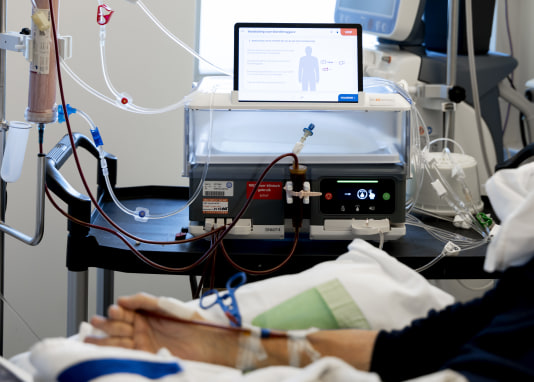
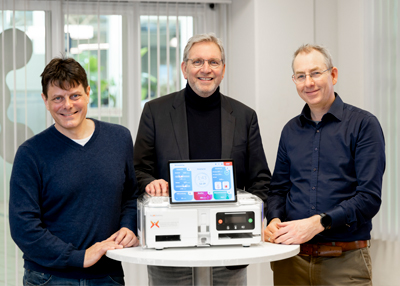
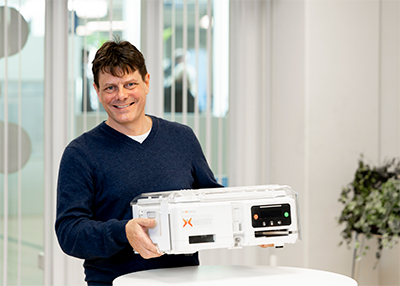
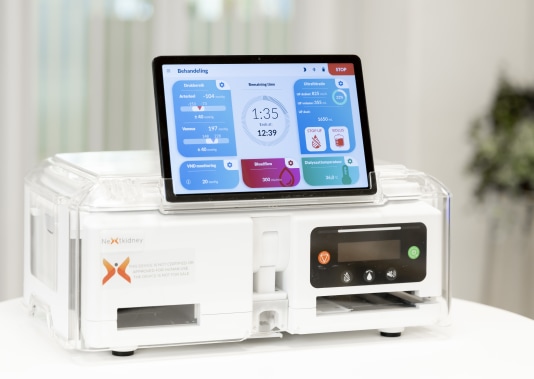
To give these patients more freedom, the Dutch Kidney Foundation (Nierstichting) launched a groundbreaking innovation in 2014: a portable artificial kidney the size of a rolling suitcase—an enormous improvement compared to the large dialysis machines used in hospitals.
This mobile dialysis system was named Neokidney and is now being tested at UMC Utrecht. These clinical trials represent an important step towards its introduction for dialysis patients.
Restoring freedom to patients
Entrepreneurship in the interest of patients
To ensure that the Neokidney actually reaches patients, the Dutch Kidney Foundation established a social enterprise specifically for this innovation. Tom Oostrom, Director of the Dutch Kidney Foundation, explains:
“We do more than raise funds; we are highly driven to make real improvements for kidney patients. Over the past decades, there has been little innovation in the dialysis market, despite the availability of technology to develop a compact and portable dialysis device. That’s when we decided: if no one else does it, we will.”
Initial tests show positive results
Internist-nephrologist Karin Gerritsen of UMC Utrecht is optimistic:
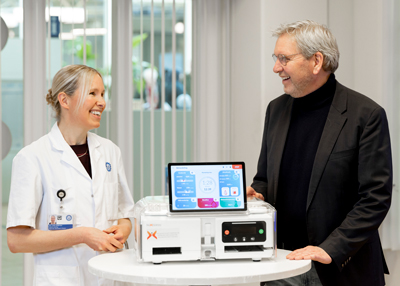
“We have been closely involved in the development of this device from the very beginning. Having the freedom to go where you want and live your life means a great deal to patients. The safety studies and initial tests in France were positive, and trials have now started in Utrecht. In the current study, we are treating approximately fifty patients over a longer period, and they are also using the device at home.”
On the path to introduction for patients
John Stooker, Director and Co-founder of Nextkidney, has also been involved since the start:
“Since 2014, our teams have been working on the design of a portable hemodialysis machine that enables patients to receive dialysis anywhere, at any time of day, without dependence on infrastructure. A device that fits into the patient’s lifestyle, rather than the other way around. We have now reached the stage where, together with the team at UMC Utrecht, we are testing the safety and effectiveness of the Neokidney with patients in the Netherlands. We are not there yet. In the coming period, we will do everything possible to complete patient trials in the Netherlands, Belgium, and France, obtain CE certification in Europe, attract additional investors, and start introducing the Neokidney to Dutch patients as soon as possible.”
Health insurers: 'a wonderful development'
Joep de Groot, Chairman of the Board of CZ, speaking also on behalf of health insurers Menzis and Zilveren Kruis, states:
“No one wants to have to go to the hospital for dialysis all the time. With the Neokidney, this can soon be done at home. We believe it is important that people can move forward and do the things that make life meaningful. For that reason, the Neokidney is a wonderful development, and we are happy to support this movement.”
Hemodialysis is a Dutch invention
Note :
For questions or interview requests, please contact Jorg Bressers, Press Officer at the Dutch Kidney Foundation, via pers@nierstichting.nl or +31 6 21542055.
For questions about or related to Nextkidney, please contact contact@nextkidney.com.
For specific questions about (the role of) UMC Utrecht and/or internist-nephrologist Karin Gerritsen, please contact Nathalie Dingeldein, Spokesperson for UMC Utrecht, via N.E.M.Dingeldein@umcutrecht.nl or +31 6 31119376.
More information about Neokidney can be found at Nierstichting.nl.
Video about the Neokidney featuring Karin Gerritsen (internist-nephrologist), Tom Oostrom (Director of the Dutch Kidney Foundation), and Janneke Bresser (kidney patient and board member of the Dutch Kidney Patients Association):