
Dutch Health Minister Sophie Hermans Visits Jack Bean Cultivation Supporting Neokidney Development
September 25, 2026 - Author : Gaëtan Pannetier
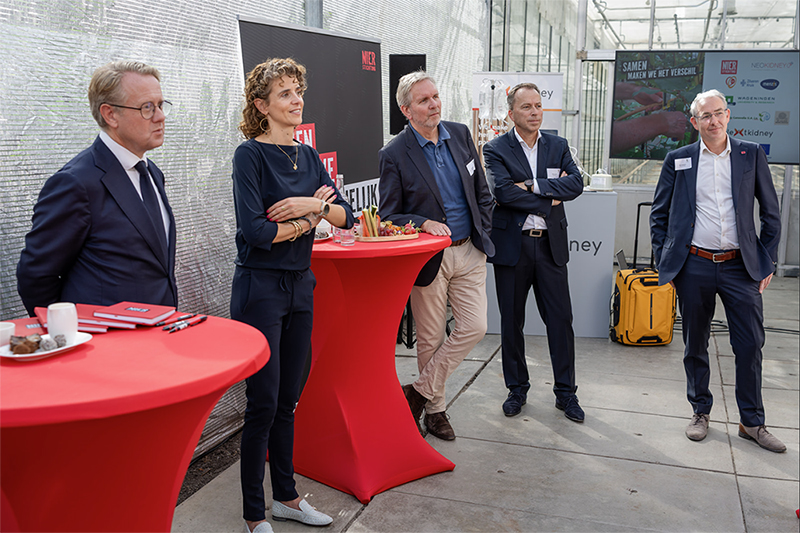
On September 24, Dutch Minister of Health, Welfare and Sport Sophie Hermans visited Innogrowers in De Lier, the Netherlands, to see first-hand how Dutch horticulture is contributing to the development of Neokidney.
The visit brought together two fields that may seem far apart at first sight: medical technology and horticulture. At their intersection is the Jack Bean, a crop that contains urease, an enzyme that plays an important role in Neokidney’s sorbent-based dialysis fluid regeneration technology.
During the visit, Minister Hermans learned more about the cultivation of Jack Beans in the Netherlands, the development of Neokidney, and the work underway to establish a reliable regional supply chain for this important raw material.
From greenhouse to dialysis technology
During hemodialysis, waste products such as urea are transferred from the blood into the dialysis fluid. Neokidney is being developed around a system that regenerates and reuses a small volume of dialysis fluid.
Urease plays a specific role in this regeneration process by helping break down urea. The enzyme can be extracted from Jack Beans, making this crop an important part of the technology behind Neokidney.
By regenerating dialysis fluid, Neokidney is designed to operate with a substantially lower fluid volume than conventional dialysis systems. This is one of the technological principles that has enabled Nextkidney to develop Neokidney as a compact and portable home hemodialysis system.
Building a reliable Dutch supply chain
Nextkidney and its partners have been working with Dutch growers, researchers and other supply-chain partners to investigate whether Jack Beans can be cultivated in the Netherlands with the quality and consistency required for urease production.
These activities are now progressing towards larger-scale cultivation.
During the ministerial visit, the first large-scale Dutch Jack Bean crop of the year was being harvested at Innogrowers. Minister Hermans marked the occasion by symbolically harvesting a Jack Bean herself.
The Dutch Jack Beans project is focused not only on cultivation, but also on developing a robust production chain, including a reproducible cultivation protocol and consistent raw-material quality.
Establishing regional production could also contribute to supply security for this medical raw material while reducing dependence on production outside Europe.
When healthcare innovation meets Dutch horticultural expertise
The collaboration reflects a broader approach to healthcare innovation.
Developing a medical device does not stop with the device itself. It also requires reliable technologies, manufacturing processes, raw materials and supply chains capable of supporting future production.
For Nextkidney, the Dutch Jack Bean initiative illustrates how expertise from different industries can contribute to the development of new approaches to dialysis care.
It also adds another Dutch chapter to a long history of innovation in dialysis. Dutch physician Willem Kolff pioneered the first successful artificial kidney treatment in the 1940s. Decades later, the Dutch Kidney Foundation initiated the development of a portable artificial kidney, which ultimately led to the creation of Nextkidney and Neokidney.
Today, that development also involves Dutch growers working to cultivate one of the raw materials used in the system.
Working towards greater flexibility in dialysis care
During her visit, Minister Hermans highlighted the impact that dialysis treatment can have on patients’ daily lives and the importance of innovations that could provide patients with greater flexibility in how their treatment is organised.
This objective has been central to the development of Neokidney from the beginning.
Neokidney is being developed as a portable home hemodialysis system designed to give eligible patients greater flexibility over where treatment can take place, while maintaining the clinical and safety requirements associated with hemodialysis.
The system is currently being evaluated through Nextkidney’s ongoing clinical development programme in Europe.
The visit to De Lier provided a tangible example of the ecosystem behind this development: patients, clinicians, engineers, researchers, growers and industrial partners, each contributing a different part of the journey.